
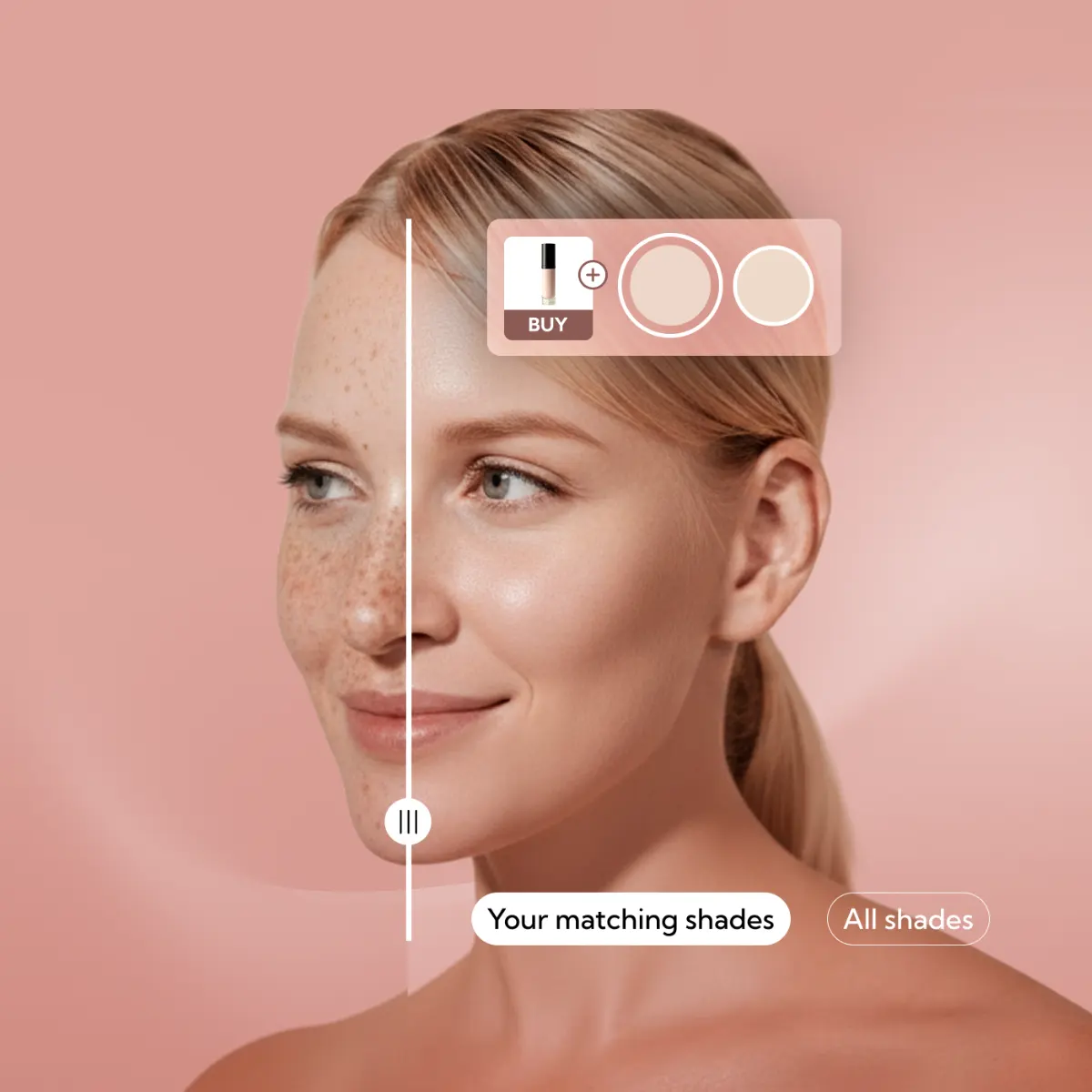
Half of all women still can’t find the right foundation shade online.
Brands that have deployed AI shade matching report up to 3x higher conversion rates and measurably fewer returns.
You’re already familiar with these issues. The question is, what is the best foundation shade finder technology for you? Which vendor can help you solve those issues? The foundation shade finder market has matured fast, and the differences between vendors are bigger than most beauty brands expect.
This is why we bring you a side-by-side look at six vendors worth evaluating in 2026.
- Shade finder vs. foundation quiz vs. virtual try-on
- What beauty brands should look for in a shade finder vendor
- Best foundation shade finder vendors reviewed (2026)
- Quick vendor comparison: best foundation shade finder technology
- Why brands are re-evaluating their shade matching systems
- Final verdict: What is the best foundation shade finder vendor in 2026
- Frequently asked questions
Shade finder vs. foundation quiz vs. virtual try-on
Part of what makes vendor evaluation confusing is that “shade finder,” “foundation quiz,” and “virtual try-on” get used interchangeably in sales conversations.
They’re not the same thing.
A shopper who doesn’t know their shade needs a recommendation. A shopper who already knows their shade but wants to see it on their face needs visualization. And a shopper clicking through a five-question quiz is mostly guessing.
These are three different problems, and the tool you pick should match the one your customers actually have.

- AI shade finder uses computer vision to detect skin tone from a selfie or live camera feed, then maps the result to actual product SKUs. It’s the most precise approach available today.
- Foundation quiz asks a few self-reported questions about skin tone and undertone. Quick to deploy, but accuracy depends on the shopper guessing correctly about their own skin.
- Virtual try-on lets shoppers see how a product looks on their face, but doesn’t necessarily recommend the right shade.
- Manual charts or swatches are still common, but they require shoppers to self-identify from a static grid, which is high-friction and unreliable on mobile.
The platforms worth evaluating combine shade finding with virtual try-on in a single experience, so the shopper gets a recommendation and can see it before buying.
What beauty brands should look for in a shade finder vendor
Now that the categories are clear, here’s what to look for when evaluating shade finder vendors specifically.
Matching accuracy matters most. How large is the training dataset? How well does the system handle varied lighting, camera quality, and undertone complexity? Right behind that is inclusivity. Does the vendor support a comprehensive scale (like the Monk Skin Tone Scale), or does it rely on a narrower range that leaves customers out?
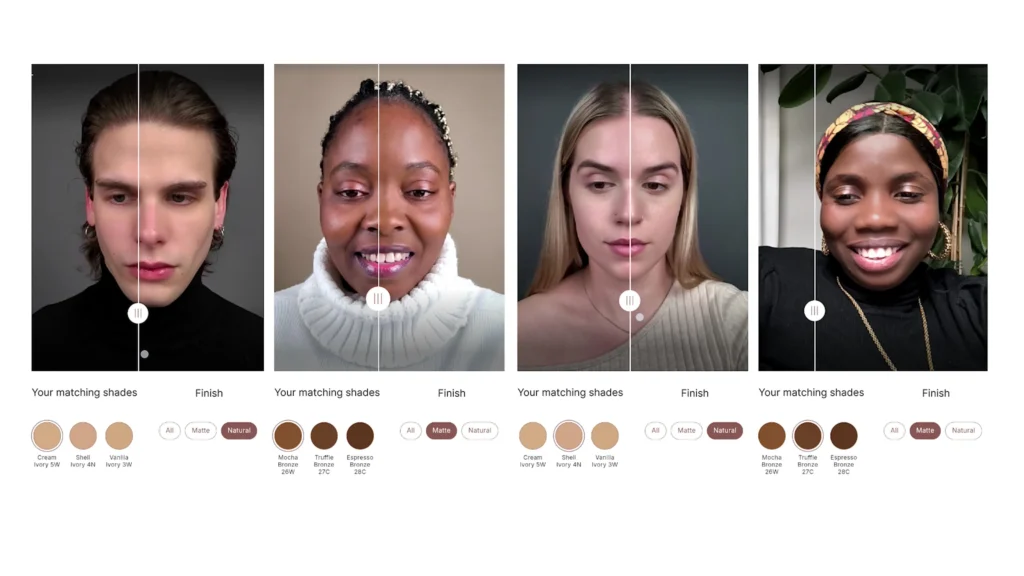
Then there’s the experience layer. Live camera vs. static selfie changes how confident the shopper feels. If the experience ends at a product card with no try-on, you’re asking someone to trust an algorithm without seeing the result. Speed should be sub-second.
On the technical side, look for lightweight SDKs (Software Development Kit) and API-first architecture that fits your e-commerce stack. An analytics dashboard that surfaces shade distribution, engagement, and conversion data. And brand customization, because the widget should look like yours, not the vendor’s.
Finally, support and pricing flexibility. Enterprise brands need a vendor that acts as a partner with real onboarding. Smaller brands need pilot options that don’t lock them into enterprise contracts.
Best foundation shade finder vendors reviewed (2026)
With those criteria in mind, here’s how the six most relevant vendors stack up in 2026.
Arbelle
Arbelle’s Shade Finder analyzes skin tone from a selfie or live camera using the Monk Skin Tone Scale, then maps results to specific product SKUs with virtual try-on in a single flow. The underlying face AI technology draws on 20+ years of R&D.
- Best for: Mid-to-enterprise beauty brands that want shade matching and try-on in one solution, with hands-on onboarding.
- Key strengths: The platform delivered a 90%+ consumer satisfaction rate in its deployment with cosnova, Europe’s best-selling color cosmetics company by volume. It supports both live camera and static selfie input, and uses the Monk Skin Tone Scale for inclusivity across the full spectrum of skin tones. Arbelle doesn’t store any images, which simplifies privacy compliance. The analytics dashboard tracks shade distribution and conversion data at the SKU level.
- Tradeoffs: Arbelle is a newer name in the shade finder market.
ModiFace
Acquired by L’Oreal in 2018, ModiFace was one of the first serious players in beauty AR. The platform detects 68 facial parameters and reported 98.3% skin tone detection accuracy in early trials across 1.6 million photos.
- Best for: Brands within the L’Oreal portfolio or those seeking a well-established AR provider with deep R&D backing.
- Key strengths: The platform benefits from L’Oreal’s R&D resources and has proven facial landmark detection across 68 parameters. AR rendering adapts to dynamic lighting conditions.
- Tradeoffs: ModiFace primarily serves the L’Oreal ecosystem, with limited availability for independent brands. There’s no public live demo.
Orbo AI
Orbo’s Shade Finder draws on 700,000+ learning samples and data from over 31 million foundation users worldwide. Beyond tone matching, the system also analyzes skin type factors like unevenness and dullness to refine its recommendations.
- Best for: Brands that want an API-first integration with offline and mobile capability.
- Key strengths: The training dataset is large and diverse, and the platform includes an undertone experimentation feature that lets shoppers adjust warmer or cooler tones. It runs offline with low power consumption and works cross-platform on Android and iOS.
- Tradeoffs: There’s no virtual try-on built in, and shade matching is limited to static selfie input with no live camera option.
PulpoAR
PulpoAR offers a broad beauty AR suite covering shade matching, virtual try-on for makeup and nails, AI skin analysis, and a generative AI tool for visualizing product collections on user-uploaded model photos.
- Best for: Brands that want an all-in-one AR toolkit spanning multiple beauty categories beyond foundation.
- Key strengths: Product coverage spans makeup, nails, and hair. The platform also offers an in-store smart mirror and a generative AI tool for product visualization. Analytics include gap identification across shade ranges.
- Tradeoffs: There’s no publicly available live demo for shade matching.
Perfect Corp
With over 950 million app downloads globally, Perfect Corp is one of the biggest names in beauty tech. Their AI Smart Shade Finder detects up to 89,969 skin tones and pairs matching with instant virtual try-on. Brand partnerships include Make Up For Ever and No7.
- Best for: Enterprise beauty brands with large SKU catalogs and multi-market presence.
- Key strengths: The shade detection range is massive at 89,969 tones, and the platform is already deployed with major global brands. It combines matching and try-on, with adaptive lighting adjustments for selfie capture.
- Tradeoffs: Enterprise pricing may not suit smaller brands, and at that scale, onboarding can feel less tailored.
Revieve
Revieve is a full-spectrum AI beauty personalization platform. Foundation matching is one component of a larger skincare and makeup advisory suite that analyzes over 200 facial and skin health metrics from a selfie.
- Best for: Brands that want foundation matching bundled with skincare diagnostics and cross-category personalization.
- Key strengths: Skin analysis covers 200+ metrics, going well beyond shade alone. Foundation matching feeds into a full skincare and makeup advisory flow. The platform has partnerships with Shiseido, Unilever, and JCPenney, with 60M+ users.
- Tradeoffs: Foundation matching is part of a broader platform, not a standalone product. It’s selfie-based only with no live camera, and shade matching isn’t the primary focus.
Quick vendor comparison: best foundation shade finder technology
| Criteria | Arbelle | ModiFace | Orbo AI | PulpoAR | Perfect Corp | Revieve |
|---|---|---|---|---|---|---|
| AI shade matching | Yes | Yes | Yes | Yes | Yes | Yes |
| Live camera analysis | Yes | Yes | Upload only | Upload/live | Yes | Upload only |
| Virtual try-on | Yes | Yes | No | Yes | Yes | Yes |
| Inclusivity framework | Monk Skin Tone Scale | Proprietary | Proprietary | Proprietary | Proprietary | Proprietary |
| Analytics dashboard | Yes | Limited (internal) | Yes | Yes | Yes | Yes |
| Open to all brands | Yes | Primarily L’Oreal ecosystem | Yes | Yes | Yes | Yes |
| Live demo available | Yes | No | No | No | Yes | No |
Why brands are re-evaluating their shade matching systems
The vendor reviews above show how much this category has matured. Brands that adopted AI shade matching early are already seeing higher conversion, lower return rates, and shoppers who trust the online buying experience enough to skip the store.
That’s raising the bar for everyone else. When your competitor’s product page offers a live camera shade match with instant try-on, a static swatch grid starts to feel like a generation behind. Accuracy matters, but the shift from quizzes to AI matching is really about removing friction. Shoppers who’ve used a good shade finder won’t go back to guessing.
There’s also a compounding benefit that’s easy to miss. Every shade match generates data on underserved tones, SKU conversion, and drop-off points. That intelligence feeds back into product development, inventory planning, and marketing. The earlier you start collecting it, the further ahead you are.
Final verdict: What is the best foundation shade finder vendor in 2026
There is no universal “best” vendor. The right choice depends on your e-commerce maturity, catalog size, budget, and how central shade matching is to your customer experience.
For beauty brands that want a dedicated shade finder with live camera support, real-time try-on, proven inclusivity through the Monk Skin Tone Scale, and a vendor that operates as a technology partner rather than a plug-in, Arbelle is built for that.
Frequently asked questions
Frequently asked questions
1. What is the best foundation shade finder technology for beauty brands?
It depends on your brand’s size, goals, and e-commerce setup. Leading options in 2026 include Arbelle, Perfect Corp, ModiFace, PulpoAR, Orbo AI, and Revieve. They differ in matching accuracy, live camera support, try-on capabilities, and pricing.
2. How does AI shade matching work?
AI shade matching uses computer vision to analyze a shopper’s skin tone from a selfie or live camera feed. The algorithm identifies tone and undertone, then maps the result to specific foundation SKUs in the brand’s catalog. Advanced systems also factor in lighting conditions, camera quality, and skin texture.
3. Is a shade finder better than a foundation quiz?
In most cases, yes. A foundation quiz relies on self-reported answers, which introduces guesswork. An AI shade finder analyzes actual skin data, which means more precise recommendations, higher conversion, and fewer returns.
4. Can shade finder technology reduce beauty returns?
Foundation returns are among the highest in beauty e-commerce, mostly due to shade mismatch. AI shade finders improve matching accuracy, which directly reduces “wrong shade” returns and gives customers more confidence to buy online.
5. What is the difference between a shade finder and virtual try-on?
A shade finder recommends the right product based on skin tone analysis. A virtual try-on lets shoppers see how a product looks on their face. They solve different problems. The most effective solutions combine both, so shoppers get a recommendation and can visualize it before buying.
Get custom demo
Contact us today to see how Arbelle’s Shade Finder performs using your real SKUs, real shades, and real customer journey goals.