
In 2025, the U.S. mass beauty market grew 5% to $72.7 billion, outperforming prestige beauty’s 4% growth. Globally, mass products command over 72% of the beauty and personal care market. And with only 14% of beauty buyers believing higher prices equal better quality, the old hierarchy is breaking down.
This piece looks at what’s actually driving mass beauty’s momentum in 2026.
Why has the “cheap equals mass” narrative run its course, and how is the new middle tier – masstige – reshaping consumer expectations? What are shoppers genuinely demanding when they say they want value?
And the brands pulling ahead? How are they using AI and automation to deliver accuracy and inclusivity at the scale that mass requires?
If you are responsible for growth, product, or innovation at a color cosmetics brand, this is the context behind the decisions on your roadmap.
What is mass market beauty?
Mass market beauty covers cosmetics and personal care products sold through high-volume channels: drugstores, supermarkets, mass merchants, and online platforms. The defining characteristic is reach. These products are available to consumers regardless of where they live or what they earn.
That reach is also what makes the category commercially compelling. A single mass beauty brand can connect with tens of millions of shoppers across markets, income levels, and demographics that specialty or department store retail simply cannot access.
Volume is not just a feature of mass beauty; it is the mechanism through which the category creates and sustains growth.
The breakdown of “price equals value”
Social platforms, ingredient transparency, and a generation of consumers who grew up reviewing products before buying them have fundamentally changed how purchase decisions are made.
Only 14% of beauty buyers today believe higher prices signal better quality. Millennials and Gen Z are evaluating products on performance, shade accuracy, representation, and peer validation, categories where a $12 foundation can outperform a $50 one.
For mass beauty brands, this shift carries real commercial weight. Competing on price alone leaves brands exposed. Competing on performance, fit, and trust builds the kind of loyalty that price promotions never could.

The rise of masstige beauty brands
Somewhere between a drugstore endcap and a department store counter, a third category has been taking share. Masstige beauty, a blend of mass accessibility and prestige positioning, has grown its global market share by five percentage points over five years, drawing consumers from both ends of the spectrum.
What is masstige beauty? The term combines“mass market” and “prestige,” and reflects a specific value proposition: the formulation standards and brand experience of prestige, at a price point that does not require a second thought at checkout. This shows up in drugstore foundations with 40-shade ranges and skincare lines with published clinical data.
The growth of masstige reflects a shift where shoppers are not trading down because they have given up on quality. They are finding quality in places the industry did not expect. For mass beauty brands, the masstige tier represents an opportunity to reposition around performance and credibility, not just availability.
What consumers actually expect when they say value in 2026
Value in 2026 has little to do with being expensive. The mass beauty consumers driving category growth are looking for four things:
- Accuracy: a foundation that matches their skin tone; a formula that works for their skin type.
- Inclusivity: shade ranges and formulations built for the full spectrum of skin tones, ages, and needs.
- Reliability: the same result every time, across every channel they buy from.
- Ease: finding the right product without spending twenty minutes in an aisle or abandoning a cart online.
Accuracy, in particular, has become a direct line to revenue. Shade mismatch is one of the leading causes of returns and negative reviews in color cosmetics. When a consumer cannot find their shade, the loss extends beyond one transaction. Research shows 50% of consumers gravitate toward brands with genuine cosmetic diversity, and 31% will actively avoid brands that fail to represent them.
Inclusivity is a baseline, not a differentiator
The benchmark was set when Fenty Beauty launched with 50+ foundation shades, rewriting consumer expectations almost overnight. Since then, brands at every price point have been held to a higher standard. But broad shade ranges alone are not enough.
Serving a diverse global consumer base through mass distribution requires more than adding shades to a lineup. It requires tools that help shoppers navigate those options, because a range of 40 foundations is only useful if consumers can identify where they sit within it.
This is where many brands still have a gap. The shade range exists on the shelf or on a product page. The guidance on how to use it confidently does not.
Arbelle’s State of Inclusivity in Beauty Report examines exactly where the industry is making progress and where the execution still falls short.

How AI makes smart value possible
AI in beauty gets talked about as a trend. For mass beauty brands running at scale, it functions more like infrastructure.
The two problems it solves most directly are shade matching and personalization, both of which have historically required either expert human guidance or a lot of consumer guesswork.
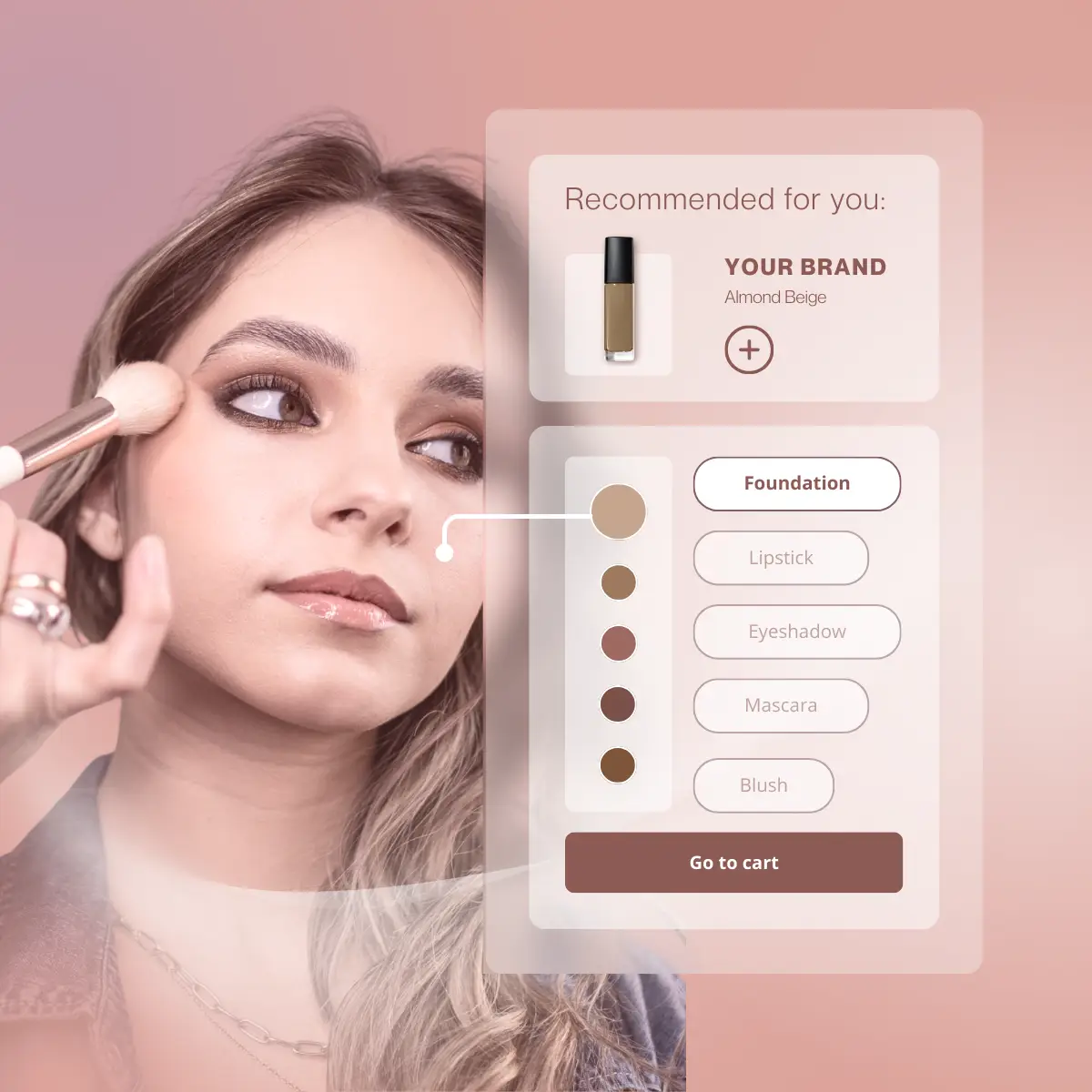
Tools like AI-powered Shade Finder analyze skin tone in real time and match consumers to the right product across the full range of existing shades. That capability alone reduces returns, improves satisfaction scores, and makes a wide shade range commercially viable rather than just visually impressive.
Virtual makeup AR adds another layer: the ability to try a product before purchasing, without being physically present in a store. For a category built on high-volume digital and omnichannel sales, this removes one of the last remaining barriers between product discovery and conversion.
Circana’s 2025 data showed mass skincare outperforming prestige in both dollar and unit sales. That outperformance tracks with better product guidance, broader accessibility, and the kind of consistent consumer experience that AI makes scalable.
The relationship between reducing cosmetic waste and deploying AR is also becoming harder to ignore as sustainability becomes a sourcing and regulatory consideration, not just a brand value.
What this means for mass beauty brand strategy
The mass beauty brands gaining ground in 2026 share a few operational characteristics. They have moved shade range expansion from a launch event to an ongoing product strategy, backed by tools that make the full range discoverable.
They are deploying virtual try-on not as a marketing feature but as a core part of the purchase journey across channels. And they are treating consumer data as input to personalization, feeding back into how products are surfaced, recommended, and merchandised.
➥ Strategy in action: A success story
A strong example of this strategy in action is cosnova, the company behind global mass beauty brands like essence and Catrice. The company recently surpassed $1 billion in annual revenue and is now the second-largest beauty provider worldwide by volume.
Its growth reflects exactly the dynamics shaping the mass segment today: accessible pricing paired with strong product performance, broad shade inclusivity, and a digitally driven approach to consumer engagement. In 2025, cosnova set another record with €991 million in net revenue, reinforcing how scale, inclusivity, and smart technology adoption are driving the next phase of mass beauty growth.

For a deeper look at how these strategies translate into measurable results, see our customer story on how cosnova approaches digital beauty experiences at scale.
The gap between brands doing this and those still relying on in-store placement and price promotion is widening. Growth in mass beauty has always rewarded scale and distribution. In 2026, it is also rewarding precision.
Arbelle works with color cosmetics brands to build the accuracy, inclusivity, and personalization capabilities that mass distribution demands. Contact us today to see what that looks like in practice.
Frequently asked questions
1. What is the difference between mass beauty and premium beauty?
Mass beauty products are sold through high-volume retail channels such as drugstores, supermarkets, and mass merchants, and are priced for broad accessibility.
Premium or prestige beauty sits in specialty retailers and department stores, at higher price points, with a stronger emphasis on brand environment and service. The quality gap between the two has narrowed considerably, and today the more meaningful difference is distribution reach and positioning rather than formulation standards.
2. What is masstige beauty?
Masstige beauty bridges the gap between mass market and prestige. Brands that price accessibly but compete on formulation quality, packaging, and brand experience typically associated with higher tiers. The category has grown steadily as consumers become less willing to pay a premium for prestige positioning alone, and as mass brands invest more seriously in performance and credibility.
3. What is mass market beauty?
Mass market beauty refers to cosmetics and personal care products distributed through high-volume retail with broad consumer accessibility as the core design principle. It is the largest segment of the global beauty market, accounting for over 72% of global beauty and personal care spend, and growing faster than prestige in the U.S. in 2025.
4. What are the key mass beauty trends in 2026?
The mass beauty trends defining the category in 2026 center on three trends.
First, accuracy. Consumers expect products that actually work for their specific skin tone and type, and brands that cannot deliver on this are seeing it reflected in returns and reviews.
Second, inclusivity as operational standard. Broad shade ranges paired with tools that make those ranges navigable, not just a wider row of swatches on a shelf.
Third, AI-driven personalization at scale, from real-time shade matching to virtual try-on, technology is becoming the mechanism through which mass beauty brands close the gap between product availability and consumer confidence.
Underpinning all three is a redefined concept of value: one built on performance and fit rather than price point alone.
Contact us
Let’s talk strategy, growth, and how beauty AI fits into your success story.