

Foundation is one of the hardest categories to sell online. Customers need to feel certain that a shade will match their actual skin tone. Not a model’s, not a stock photo, not their best guess from a static chart.
That uncertainty shows up directly in cart abandonment, return rates, and customers who don’t come back a second time.
AI foundation shade matching solves this problem in a way no quiz or swatch chart can. This AI foundation shade finder guide explains how the technology works, what separates good implementations from weak ones, and what results beauty brands can realistically expect.
- Why foundation shade matching matters for beauty e-commerce
- What is a foundation shade finder (and how it differs from a quiz or try-on)
- Why shade charts, quizzes, and manual matching fall short
- How AI foundation shade matching works, step by step
- What is the Monk Skin Tone Scale, and why it matters for foundation shade matching
- What to look for in AI foundation shade finder technology
- How shade finders generate first-party data and product insights
- How AI shade matching reduces foundation returns and increases conversion
- How to choose the best foundation shade matching technology for your brand
- Frequently asked questions
Why foundation shade matching matters for beauty e-commerce
Foundation returns are expensive in a way that most other beauty categories aren’t.
A returned mascara or lipstick can sometimes be restocked. A returned foundation is almost always destroyed for hygiene reasons, with processing costs running between $20 and $33 per return. And shade mismatch drives an estimated 60% of those returns. That’s the back end.
On the front end, average beauty e-commerce conversion sits between 2.5% and 3%, with cart abandonment between 72% and 82%, and 60% of shoppers who won’t buy foundation online without some kind of shade-matching tool in place. For most brands, that’s a significant share of potential revenue sitting behind a friction point that’s entirely solvable.
Shade matching addresses a conversion and retention problem that compounds over time. A wrong shade means a disappointed customer who is unlikely to come back, and a return that costs money on both ends.
What is a foundation shade finder (and how it differs from a quiz or try-on)
A foundation shade finder is an AI-powered tool that analyzes a customer’s skin tone from a selfie or live camera feed, then maps the result to specific product SKUs in a brand’s catalog. The recommendation comes from actual skin analysis, not guesswork.
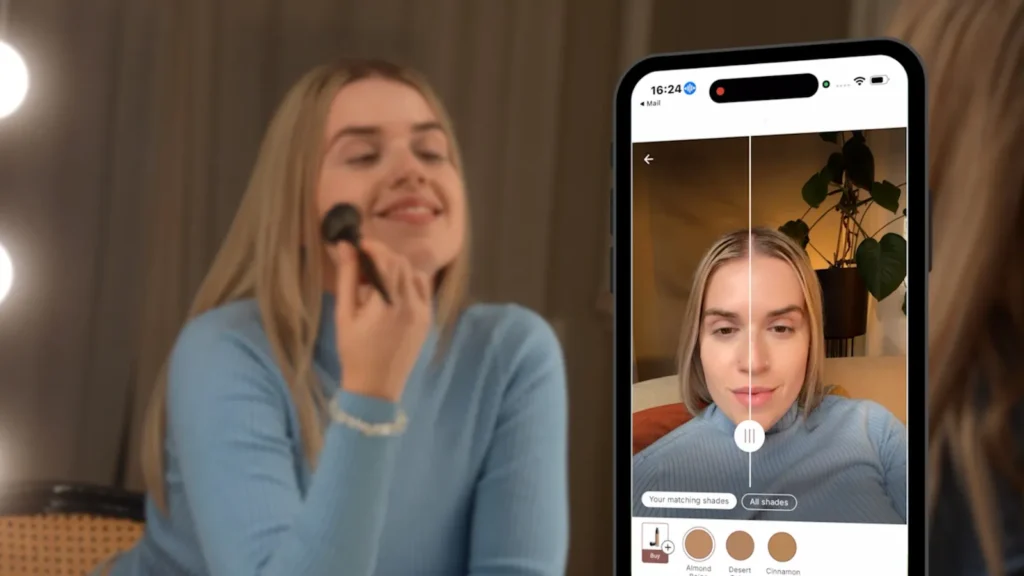
It gets confused with two other tools constantly, and the distinction matters.
A foundation quiz asks customers to self-report their skin tone, undertone, and preferences. The problem is that most people don’t know their undertone or even skin tone, and self-reported data is unreliable. A quiz can only ever be as accurate as the answers it receives.
A virtual try-on solves a different problem. It lets customers visualize how a shade looks on their face, which builds purchase confidence. But it doesn’t tell them which shade to pick in the first place. Without an accurate recommendation feeding into it, try-on is a visualization tool, not a matching tool.
The most effective platforms combine shade matching and try-on into a single experience. The customer gets a recommendation, sees it on their face, and buys with confidence. That combination is what drives meaningful lift in conversion and reduction in returns.
➢ Read more on this distinction in Arbelle’s comparison of foundation quiz vs. AI foundation match.
Why shade charts, quizzes, and manual matching fall short
Static swatch charts require customers to identify their own shade from a grid of small color tiles, often viewed on screens with variable color accuracy. Even when a customer picks carefully, there’s no guarantee the tile on their monitor reflects the actual pigment in the bottle.
Quizzes, on the other hand, ask customers to self-report skin tone and undertone, assuming they know both. Most don’t. Email or chat support can work for a small number of customers, but doesn’t scale to e-commerce volume. In-store matching is the most accurate traditional method, but it’s entirely unavailable to the customer browsing at home.
Uncertainty at the point of purchase is expensive. A customer who isn’t sure about their shade doesn’t just hesitate. They often leave. And if they do buy and get it wrong, the return experience makes them reluctant to try again online.
Foundation is a trust-intensive purchase, and legacy tools don’t build trust at the point of decision.
The inclusivity failure in older systems makes this worse.
Many legacy matching tools were trained on limited datasets that skewed toward lighter skin tones. Customers with deeper, olive, or golden complexions received inaccurate recommendations or found their shade range wasn’t represented at all.
This affects a large share of the global beauty market, and those customers have learned from experience that online shade matching often doesn’t work for them. A brand that breaks that pattern earns something that’s genuinely hard to win back once lost: trust from an underserved customer.
➢ Check out the results of our foundation range analysis of 7 major beauty brands.

How AI foundation shade matching works, step by step
AI shade matching addresses the very issues that traditional tools fail at. Why? Because it removes both the guesswork and the screen-color problem by analyzing the customer’s actual skin in real time.
Our AI foundation shade finder guide brings you the step-by-step overview of how the process works.
| Step 1. Image capture | The customer enables their camera or uploads a photo. Natural lighting and a bare face give the AI the clearest signal. Modern systems guide users on positioning and lighting to improve accuracy before analysis begins. |
| Step 2. Facial tracking and landmark detection | The AI detects and maps more than 150 facial landmark points (in Arbelle’s case), allowing it to accurately isolate the skin area while accounting for face angle, distance from the camera, and ambient lighting conditions. |
| Step 3. Skin tone and undertone analysis | Using deep learning, the system analyzes tone, undertone, and complexion variations across the identified skin area. Advanced models like Arbelle’s draw on the Monk Skin Tone Scale to ensure the analysis covers the full human spectrum, not just a narrow subset. |
| Step 4. Product matching | The analyzed skin profile is compared against the brand’s product database, returning ranked recommendations across the available range and accounting for shade, coverage, finish, and product type. |
| Step 5. Virtual try-on | The recommended shade is rendered on the customer’s face in real time using augmented reality, so they see exactly how the product looks on their actual skin before buying. |
| Step 6. Cross-category recommendations | The most capable platforms extend the match across related products, suggesting complementary concealers, powders, or blushes based on the same skin profile. This is a direct driver of average order value. |
➥ For a deeper look at the skin analysis layer, see Arbelle’s guide to AI skin tone analysis.
What is the Monk Skin Tone Scale, and why it matters for foundation shade matching
The Monk Skin Tone Scale is a 10-shade scale developed by Google and Harvard sociologist Dr. Ellis Monk. It was designed to address the failings of the Fitzpatrick scale, the previous industry standard, which was primarily built around lighter skin tones and performed poorly for darker and more complex skin tones.
The scale is open-source, scientifically validated, and designed to be used consistently across different annotators and systems. Its 10 points balance genuine diversity with practical usability, and research shows users find it as representative as cosmetic scales with far more gradations.
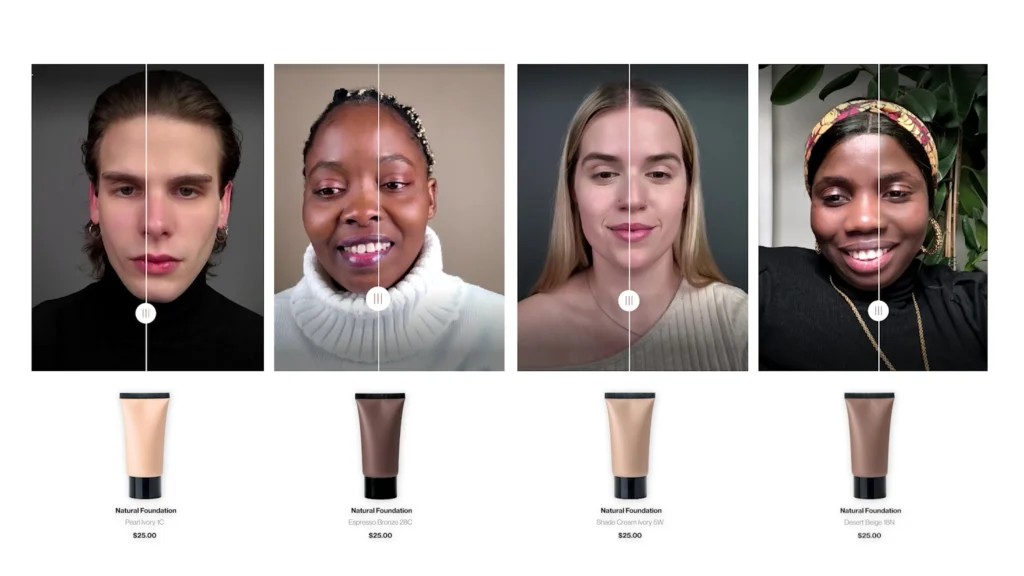
✧ Why does this matter?
Black consumers report a 5.7x higher dissatisfaction rate with makeup shopping compared to non-Black consumers. Customers with olive, golden, or deep complexions have historically been underrepresented by shade tools built on narrower datasets. When those customers find a tool that works for them, the trust it builds translates directly into conversion and retention. A brand that serves the full spectrum of skin tones reaches a larger market.
Arbelle’s Shade Finder is built around the Monk Skin Tone Scale, making it one of the few tools on the market that treats inclusivity as a design requirement rather than a feature added after the fact.

For more on this, see Arbelle’s inclusivity in beauty report and the analysis of inclusive makeup brands.
What to look for in AI foundation shade finder technology
Not all shade finders produce the same results. These are the features that matter.
| Matching accuracy and training data | A larger, more diverse training dataset directly improves accuracy across skin tones. Ask vendors about dataset size, demographic representation, and how the system handles undertone complexity. Monk scale coverage is a meaningful signal here. |
| Live camera support | Static selfie input works, but live camera is significantly more engaging, and engagement correlates directly with conversion. A shopper interacting with a live tool for 60 seconds is far more likely to buy than one who uploads a photo and reads a result. |
| Integrated virtual try-on | Matching and visualization should be part of the same experience. Separating them breaks the confidence-building flow. |
| Speed | Results should appear in under a second. Any perceptible delay increases drop-off. |
| Analytics dashboard | A shade finder generates data on shade demand, product performance, skin tone distribution, and conversion by segment. That data is only useful if you can access it. Ask what the analytics layer looks like before you commit. |
| Integration flexibility | SDK (Software Development Kit) and API-first architecture lets brands embed the experience into any e-commerce stack without a heavy technical lift. Ask about deployment timelines and compatibility with existing platforms. |
| Brand customization | The widget should look like yours, not the vendor’s. |
| Support model | A shade finder requires ongoing calibration, product catalog updates, and performance optimization. Vendors that operate as partners rather than plug-in providers produce better long-term outcomes. Arbelle’s approach to beauty technology partnerships is built around this. |

Top shade finder vendors compared
➥ For a more detailed overview of foundation shade matching solutions and a side-by-side look at main vendors in 2026, read our article.
How shade finders generate first-party data and product insights
Every shade match interaction generates data that most brands are currently leaving uncollected.
Which skin tones are searching for products most frequently? Which shades have high search volume but low match rates, suggesting a gap in the product range? Where are customers dropping off in the shade-finding flow? Which recommendations convert and which get dismissed?
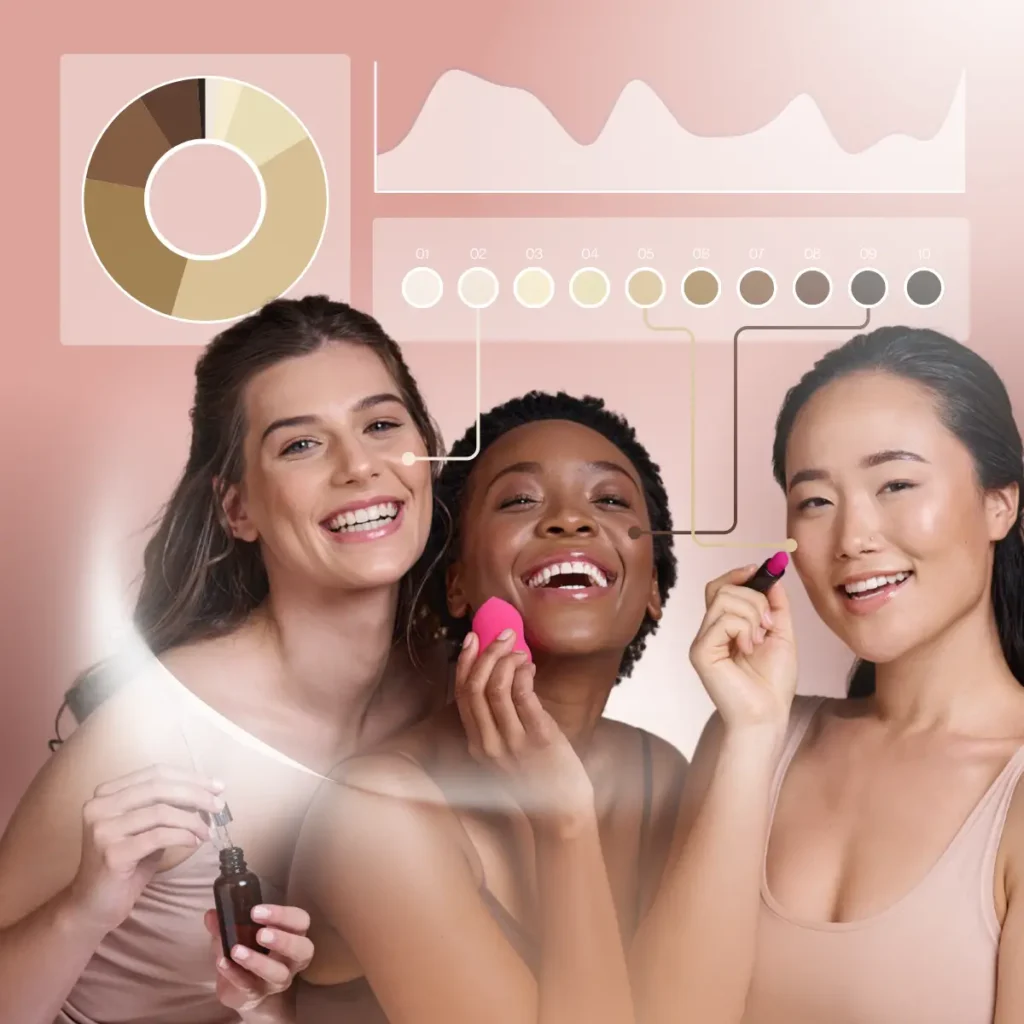
Brands using Arbelle’s analytics have used shade demand data to inform new product launches, identify underserved skin tone segments, and optimize shade assortment decisions ahead of seasonal campaigns. The data tells you things your sell-through numbers can’t.
The first-party dimension matters here, too. As third-party tracking becomes less reliable, every shade match is an opportunity to build a consented, high-quality data asset. A customer who completes a shade match has given the brand a direct signal about their skin profile, their product interests, and their purchase intent.

➥ For more on this, see Arbelle’s guides on first-party data in beauty and ethical data practices.
How AI shade matching reduces foundation returns and increases conversion
The outcomes are consistent across independent deployments. Brands report conversion rate and sales lifts following shade finder implementation. Return rates for shade-matched purchases fall by an estimated 20 to 30%. Average order value increases when the shade finder experience includes complementary product recommendations.
Arbelle’s deployment with cosnova, Europe’s best-selling color cosmetics company by volume, delivered a 90%+ consumer satisfaction rate.

Sephora reported a 30% increase in online sales after implementing AI-driven recommendations and AR try-ons.
Customers who find their shade with confidence buy. Customers who buy the right shade don’t return it. And customers who don’t return it come back.
Read more:
How to choose the best foundation shade matching technology for your brand
The shade finder market has matured, and the differences between vendors are big. The right choice depends on your scale, e-commerce maturity, catalog size, and what you need from the analytics layer.
For a full breakdown of the leading vendors evaluated against the criteria above, see Arbelle’s comparison of foundation shade finder vendors in 2026.
For brands in the research phase, Arbelle’s foundation shade finder and full suite of beauty technology solutions are a practical starting point for understanding what modern AI shade matching can deliver.
Frequently asked questions
Frequently asked questions
1. How does an AI shade finder work?
An AI shade finder captures a customer’s skin tone from a selfie or live camera, maps it using a skin tone scale, then matches it to specific foundation SKUs in the brand’s catalog. Advanced systems include undertone analysis, lighting correction, and virtual try-on. Arbelle’s technology builds on the Monk Skin Tone Scale for accuracy across all complexions.
2. Can AI match foundation shades accurately?
Yes, when built on a sufficiently large and diverse training dataset. Tools trained on the Monk Skin Tone Scale, with live camera input and real-time lighting adjustment, consistently achieve 90%+ match accuracy. The key variable is training data quality and the comprehensiveness of the product catalog integration.
3. What is the Monk Skin Tone Scale in beauty?
The Monk Skin Tone Scale is a 10-shade open-source scale developed by Google and Harvard’s Dr. Ellis Monk. It was designed to replace the Fitzpatrick scale, which underrepresented darker and more complex skin tones. It’s now the standard reference for inclusive AI skin tone analysis and is used by Arbelle as the core of its shade matching system.
4. Is Shade Finder better than a quiz?
In almost every measurable dimension, yes. A quiz relies on self-reported answers, which are often inaccurate since most customers don’t know their undertone. An AI shade finder analyzes actual skin data, producing a recommendation grounded in computer vision rather than self-description. The result is higher accuracy, higher conversion, and fewer returns.
5. How to reduce foundation returns in e-commerce?
AI shade matching directly addresses the primary cause of foundation returns: wrong shade. Brands that implement AI shade finders with virtual try-on report 20 to 30% reductions in shade-related returns. The most effective implementations combine accurate matching with live try-on, so customers see the recommended shade on their own face before buying.
6. What features matter most in a foundation shade finder?
Matching accuracy across all skin tones, live camera support, integrated virtual try-on, a built-in analytics dashboard, and brand customization. Inclusivity, measured by training dataset breadth and the skin tone scale used, is a strong predictor of both accuracy and customer trust.
Get your virtual foundation shade finder
Get in touch with our team to explore Arbelle’s Shade Finder technology and see how it fits into your business.